Water is the single most important resource for tree health in Albuquerque. With average annual rainfall of just 9 to 10 inches and summer temperatures that regularly push past 90 degrees, most urban trees in our area depend entirely on supplemental irrigation to survive and thrive. The problem is that many Albuquerque homeowners are either under-watering their trees, watering in the wrong places, or relying on turf-focused sprinkler systems that never reach the root zone where trees actually need moisture.
Drip irrigation solves these problems by delivering water slowly, directly to the soil surface, where it can soak deep into the root zone with minimal evaporation and zero runoff. At Legacy Tree Company, we design, install, and maintain tree-focused irrigation systems that prioritize deep, efficient watering tailored to Albuquerque’s arid climate. Here is what homeowners need to know.
Why Trees Need Different Irrigation Than Turf
One of the most common irrigation mistakes in Albuquerque is assuming that a sprinkler system designed for grass is adequate for trees. It is not, and the difference matters.
Turf irrigation is designed to wet the top 6 to 12 inches of soil frequently. Tree roots, by contrast, extend 12 to 36 inches deep and can spread one and a half to four times the diameter of the crown. A sprinkler that keeps grass green delivers water to a zone that is far too shallow for tree roots and often pools water around the trunk, which can lead to root rot and fungal problems.
Trees need deep, infrequent watering that soaks the entire root zone. This encourages roots to grow downward and outward, building the kind of extensive root system that provides stability, drought resilience, and access to nutrients. Shallow, frequent watering does the opposite: it trains roots to stay near the surface, making the tree more vulnerable to heat stress, wind, and drought.
Legacy Tree Company’s irrigation systems are designed specifically for trees and adapted plantings, not turf. The focus is always on getting water to where roots can actually use it.
How Drip Irrigation Works for Trees
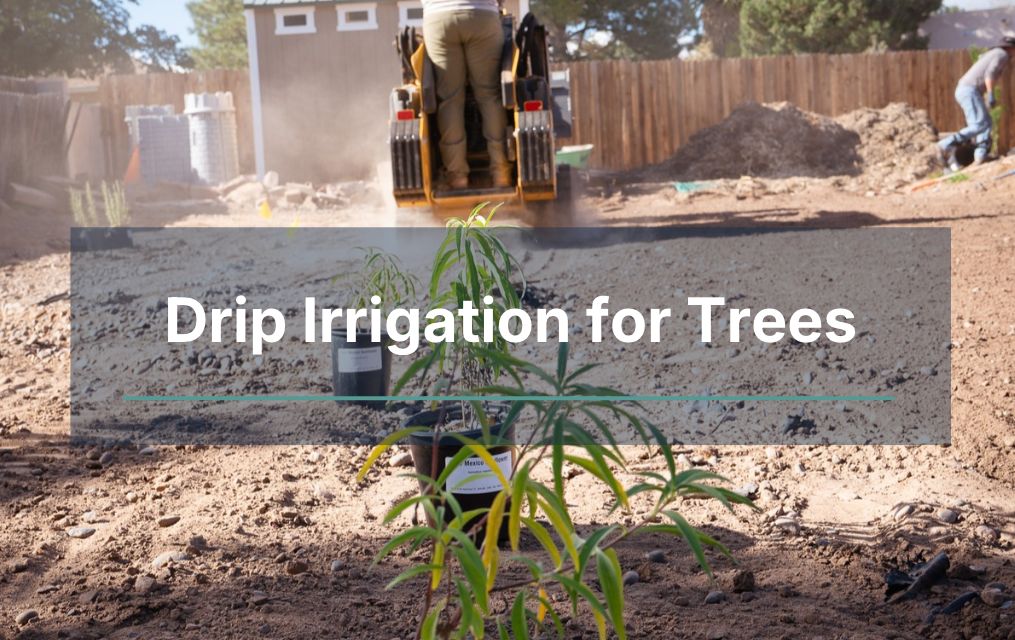
A drip irrigation system delivers water through a network of tubing and emitters placed at the soil surface. Unlike sprinklers, which spray water into the air where much of it evaporates before reaching the ground, drip emitters release water slowly and directly into the soil.
For trees, drip emitters should cover a wide ring of soil inside and beyond the drip line, the imaginary circle on the ground that matches the outer edge of the crown Start the watering zone about halfway between the trunk and the crown edge, and extend it the same distance beyond the crown edge. For a tree whose crown reaches 10 feet from the trunk, that means watering the soil from about 5 to 15 feet out. This is where the majority of a tree’s fine feeder roots are located. Placing emitters too close to the trunk concentrates water where it is not needed and increases the risk of trunk rot and root disease.
As a tree grows, its root zone expands. A properly designed system accounts for this by using concentric rings of emitters or flexible layouts that can be expanded outward as the crown develops. A system installed when a tree is young should not stay in the same configuration five or ten years later.
Setting Up a Drip System for Trees in Albuquerque
Whether you are installing a new system or converting an existing sprinkler setup, several key principles apply.
Hydro-Zoning
Trees, shrubs, groundcovers, and turf all have different water requirements. Mixing them on the same irrigation zone means something is always getting too much or too little water. Legacy Tree Company designs systems with separate zones for trees and lower-water plantings, allowing each group to receive the frequency and duration it actually needs.
Emitter Placement and Spacing
For established trees, emitters should be spaced in rings that start about halfway between the trunk and the drip line and continue beyond it. The goal is to wet a broad area of soil rather than a single point, which encourages a more dispersed and resilient root system. A single emitter at the base of a tree creates a narrow cone of wet soil and a correspondingly narrow root system, leaving the tree poorly anchored and vulnerable.
Run Time and Frequency
In Albuquerque’s sandy to clay soils, drip systems for trees should run long enough to soak the soil to a depth of 2 to 3 feet. This typically means longer run times at lower frequency, perhaps once every 7 to 14 days during summer for established trees, rather than short daily cycles. Newly planted trees may need watering two to three times per week during their first summer while roots are establishing.
Pressure Regulation and Filtration
Drip systems operate at lower pressure than sprinklers. A pressure regulator prevents emitters from blowing out or delivering water too fast. A filter upstream of the emitters prevents sediment from clogging the small openings. Both components are essential for reliable long-term performance.
Common Drip Irrigation Mistakes
Watering at the Trunk
This is the most frequent mistake Legacy Tree Company sees on Albuquerque properties. Emitters placed right at the base of the tree deliver water where there are very few absorbing roots and create conditions that promote trunk rot, root crown disease, and fungal growth, and it’s not enough water for the tree. Water should be delivered across the root zone, starting about halfway out to the crown edge and extending past it, not pooled against the trunk.
Keeping the Same Setup as the Tree Grows
A drip system installed for a newly planted tree with a 4-foot crown is not adequate for that same tree when it has a 20-foot crown five years later. As the tree grows, the irrigation system needs to expand outward to follow the developing root zone. Legacy Tree Company designs systems with future growth in mind and recommends periodic adjustments as the landscape matures.
Watering Too Frequently and Too Shallowly
Short, daily irrigation cycles keep the top few inches of soil moist but never penetrate to the deeper root zone. This trains roots to stay shallow and leaves the tree chronically under-resourced below the surface. Switching to longer, less frequent watering cycles encourages deep root development and builds genuine drought resilience.
Ignoring Seasonal Adjustments
Trees need significantly more water during Albuquerque’s hot summer months than they do in spring or fall, and established trees still need a deep watering about once a month during winter dormancy. A system running on the same schedule year-round is either over-watering in winter or under-watering in summer. Seasonal adjustments to run times and frequency are essential.
Neglecting Maintenance
Clogged emitters, cracked tubing, damaged fittings, and filter buildup all reduce system performance over time. A system that was delivering adequate water two years ago may be running at a fraction of its capacity today without anyone noticing until the tree starts showing stress.
Maintaining Your Drip System
Regular maintenance keeps your irrigation system performing as designed and protects your investment in your trees.
Monthly during the growing season: Run the system and visually inspect each emitter for clogs, leaks, or damage. Check that water is flowing at the correct rate. Flush the lines periodically to clear sediment.
Seasonally: Clean or replace filters. Adjust run times and frequency based on the current season and weather conditions. Check for tubing that has been displaced by landscaping activity, pets, or weather.
Annually: Evaluate the overall system layout relative to tree growth. If crowns have expanded significantly, emitters may need to be added or repositioned outward. Legacy Tree Company can perform annual irrigation assessments and make adjustments as part of a broader tree care plan.
Before winter: Drain the system to prevent damage from freezing temperatures, which can crack tubing and fittings. Albuquerque’s winter lows regularly drop below freezing, and even a single hard freeze can damage an unprepared system. Draining the drip lines does not mean your trees stop needing water. Plan to water established trees deeply about once a month through winter, using a hose on a mild day when the ground is not frozen.
When to Call Legacy Tree Company
Legacy Tree Company is not a sprinkler company and does not install or repair conventional turf irrigation systems. What we do is design and install tree-focused irrigation systems that deliver water where trees need it most, across the full root zone rather than at the surface.
Our arborists can evaluate your existing irrigation setup and determine whether your trees are actually receiving adequate water. In many cases, trees that appear to be diseased or declining are actually suffering from chronic under-watering that has accumulated over years. Correcting the irrigation issue often resolves the visible symptoms without any other intervention.
When a complete redesign is needed, Legacy Tree Company can install new valves, run new hard lines, and convert water-wasting turf setups into efficient systems that support trees and lower-water landscape plantings. Our approach emphasizes broad, deep, and less frequent watering that supports both healthy tree growth and native grasses.
Frequently Asked Questions
How much water does a tree need in Albuquerque?
Water needs vary by species, size, age, soil type, and sun exposure. As a general guideline, established desert-adapted trees may need deep watering every 7 to 14 days during summer, while higher-water species may need it about once a week, and newly planted trees two to three times per week during their first summer. Legacy Tree Company provides specific watering recommendations as part of every tree planting and irrigation project. For the principles behind broad, deep watering, see our post on proper tree irrigation.
How do I know if my trees are getting enough water?
A soil probe or a long screwdriver is a simple diagnostic tool. If it pushes easily into the soil to a depth of 2 feet, your watering is reaching the root zone. If it meets resistance at just a few inches, your trees are likely under-watered. Visible signs of drought stress include wilting, yellowing leaves, premature leaf drop, and crown thinning.
Can I convert my sprinkler system to drip for my trees?
In many cases, yes. Legacy Tree Company can evaluate your existing system and recommend modifications or a full conversion that redirects water from turf irrigation to tree-focused drip. This often results in healthier trees and lower water bills.
Does mulch help with tree irrigation?
Yes. A 3 to 4 inch layer of organic mulch around the base of the tree (kept away from the trunk) helps retain soil moisture, moderate soil temperature, and suppress weed competition. Legacy Tree Company produces high-quality arborist mulch from their tree care operations and uses it extensively to improve landscapes.
What areas does Legacy Tree Company serve for irrigation?
Legacy Tree Company serves Albuquerque, Corrales, Los Ranchos, Tijeras, and Cedar Crest.
Give Your Trees the Water They Actually Need
In Albuquerque’s arid climate, the right irrigation setup is the difference between a tree that thrives and one that slowly declines. Legacy Tree Company designs, installs, and maintains tree-focused drip irrigation systems that deliver deep water across the full root zone, conserving resources while promoting strong, sustained growth.
Contact Legacy Tree Company at (505) 312-8865 or visit legacytreecompany.com/estimate to schedule your irrigation assessment.