Not every tree with a structural problem needs to come down. Trees with co-dominant stems, tight branch attachments, heavy lateral limbs, or storm damage can often remain safely in the landscape with the right support system in place. Tree cabling and bracing provides that support, reducing the risk of failure while preserving a tree’s canopy, shade, and value.
At Legacy Tree Company, our arborists enjoy the challenge of designing and installing support systems that make a tree safer, keeping it in the landscape for many more years rather than defaulting to removal. But cabling is not a solution for every situation, and knowing when it works and when it does not is what separates a science-based recommendation from a guess.
What Is Tree Cabling and Bracing?
Cabling and bracing are two complementary techniques arborists use to provide physical support to trees with structural weaknesses.
Cabling involves installing flexible ropes or cables between major branches or stems high in the canopy. These connections limit how much independent movement can occur between the attached stems, reducing the forces on weak attachment points during wind events. Think of it like the rails in a bowling alley: the cable does not prevent movement entirely, but it keeps things within a safe range.
Bracing involves inserting threaded steel rods through weak unions, splits, or cracked trunks to provide direct lateral support. Bracing physically holds separating stems or sections together and is typically used when a union has already begun to fail or is at high risk of splitting.
These systems are often installed together, with cabling in the upper canopy to reduce leverage forces and bracing at the point of weakness below.
When Cabling and Bracing Is the Right Solution
Cabling and bracing are most effective on trees that have a specific structural weakness but are otherwise healthy and worth preserving. Our arborists evaluate several factors before recommending a support system.
Co-Dominant Stems with Included Bark
This is the most common reason for cabling in Albuquerque. When two or more stems of roughly equal size grow from the same junction, they often form a tight, V-shaped attachment with bark trapped between them. This included bark prevents strong wood fibers from fusing the stems together, creating a weak point that is prone to splitting under wind load. A well-placed cable system limits the movement between these stems and significantly reduces the chance of catastrophic failure.
Heavy or Over-Extended Limbs
Large lateral branches that extend far from the trunk carry enormous leverage, especially during wind events. If a limb is heavy enough to pose a risk but the tree is otherwise sound, cabling can support that limb without removing it. This is particularly relevant for mature trees in Albuquerque where a single large branch may provide significant shade.
Storm-Damaged Trees
When a windstorm churns through the canopy and leaves behind cracked or partially split branches, cabling and bracing can sometimes stabilize the damage and allow the tree to heal. Not every storm-damaged tree is a candidate, but many can be saved with timely intervention.
Trees with Historical or Aesthetic Value
Some trees are worth saving even when the structural investment is significant. A century-old shade tree on a historic property, a specimen tree with irreplaceable canopy coverage, or a tree with deep personal significance to the homeowner may all justify a support system that would not make financial sense on a replaceable landscape tree.
When Cabling Will Not Work
Cabling and bracing are not universal solutions. Our arborists will be direct about when a tree has crossed the threshold from manageable risk to genuine hazard.
Extensive internal decay. If the trunk or major branch unions are compromised by advanced decay, there may not be enough sound wood to anchor a cable or support a brace rod. A support system cannot strengthen wood that is no longer there.
Dead trees. Cabling will not help a dead tree. Dead wood is brittle and unpredictable, and no amount of external support changes that fundamental reality.
Root system failure. If a tree’s roots are compromised to the point where the tree is at risk of uprooting, a canopy cable does nothing to address the real problem. Root stability must be assessed as part of any cabling evaluation.
Severe lean with soil heaving. A tree that has begun to lean with visible soil lifting on the opposite side is likely in the process of falling. This is a removal situation, not a cabling situation.
Our Approach: The Cobra Dynamic System
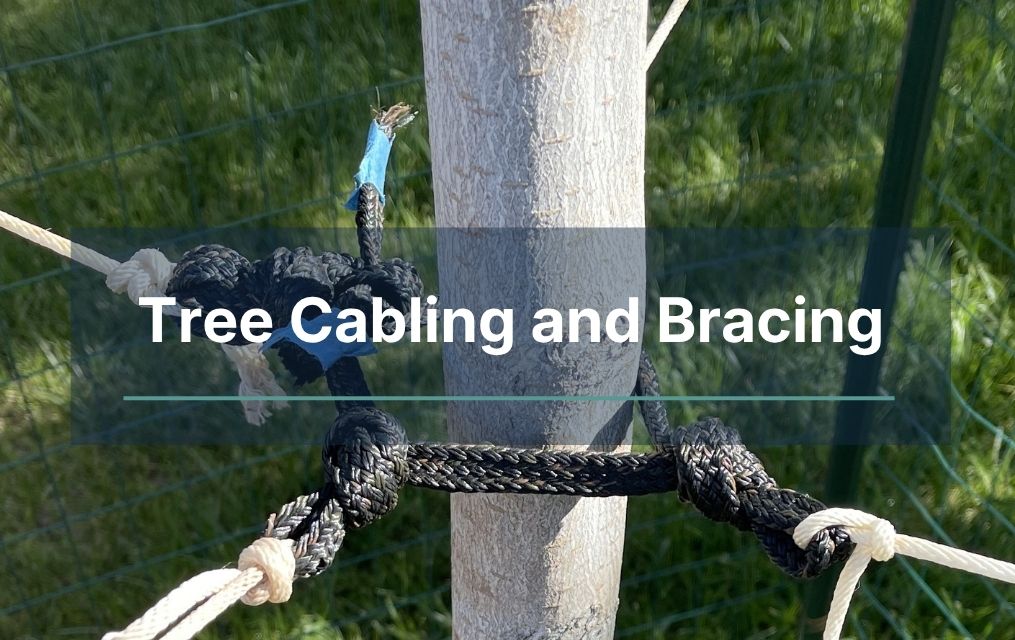
We use the Cobra Dynamic Bracing system for most cabling installations. Unlike traditional static steel cables that are bolted through the interior of branches, the Cobra system is entirely external and non-invasive.
The system uses industrial-strength woven polypropylene rope threaded with a rubber shock absorber. It wraps around the mature stems without penetrating the bark or drilling into the wood. This is significant because traditional bolt-and-cable installations create wounds that can become vectors for decay, potentially introducing new problems while trying to solve existing ones.
The Cobra system also builds in slack to accommodate the tree’s ongoing growth. As stems increase in girth over the years, the system adjusts rather than constricting the branch. It limits how much movement can occur between the attached stems while still allowing enough natural sway for the tree to continue strengthening itself, since movement is what triggers a tree to grow reinforcing wood at stress points.
The Role of Pruning Alongside Cabling
Cabling and bracing rarely stand alone as a treatment. In most cases, our arborists combine support systems with targeted pruning to reduce weight, improve balance, and address the structural conditions that created the risk in the first place.
Weight reduction on over-extended limbs lowers the forces acting on weak unions. Removing dead wood eliminates unpredictable failure points. Structural pruning can improve the overall form of the tree, making the cabling system more effective and extending its functional life.
For young trees, structural pruning alone can often prevent the conditions that lead to cabling needs later in life. Our arborists emphasize that trees with straight central trunks and well-spaced branches with wide attachment angles are inherently stronger than trees with multiple competing stems. Investing in formative pruning when a tree is young is one of the most effective ways to avoid expensive corrective work decades down the road.
What the Installation Process Looks Like
Once our arborist determines that cabling is appropriate, the installation process is straightforward.
Our arborist designs the system based on the tree’s specific structure, identifying the attachment points that will provide the most effective support. Cable placement is typically in the upper third of the canopy, positioned to limit movement between the stems that are at greatest risk.
Our climbing arborists position the cables, adjust tension and slack, and verify that the system functions as designed. The entire process is typically completed in a single visit, and the system is virtually invisible from the ground once installed.
Ongoing Monitoring and Maintenance
A cabling system is not a set-it-and-forget-it solution. Trees continue to grow, weather events test the system, and conditions change over time. We recommend periodic inspection of all cabling and bracing installations to verify that the system remains functional and that the tree’s condition has not changed in ways that alter the risk profile.
During inspections, our arborist checks cable tension, looks for signs of new decay or structural change, evaluates whether the tree’s growth has affected the system, and determines if any adjustments or additional pruning are needed. These inspections are typically part of a broader tree health consultation that covers all the trees on your property.
Cabling and Bracing vs. Removal: Making the Decision
The decision between supporting a tree and removing it comes down to a few key factors.
Is the tree otherwise healthy? A tree with one structural weakness but an otherwise healthy canopy, sound trunk wood, and stable root system is a strong candidate for cabling.
What is below the tree? A tree overhanging a bedroom, a driveway where cars park daily, or a play area carries higher consequences if it fails. The higher the target value, the more carefully the risk must be managed.
What would replacement cost? A mature shade tree that took 30 years to grow cannot be replaced overnight. The shade, property value, and aesthetic contribution of a large tree are significant, and preserving it is often worth the investment in a support system.
What does the arborist recommend? Our ISA Certified Arborists, including TRAQ-qualified risk assessors, evaluate every factor before making a recommendation. Our goal is always to recommend what is genuinely best for the tree and the property, whether that means cabling, pruning, or removal.
Frequently Asked Questions
How long does a cabling system last?
Dynamic cabling systems like the Cobra system are designed for long-term use but should be inspected periodically. The system’s built-in slack accommodates growth, and the materials are engineered to withstand weather exposure. We will recommend an inspection schedule based on your tree’s specific conditions.
Does cabling hurt the tree?
The Cobra Dynamic system we use is non-invasive, wrapping around stems without drilling or penetrating the bark. This avoids creating wounds that could introduce decay, which is a known drawback of older bolt-and-cable systems.
How much does tree cabling cost?
Cost depends on the size of the tree, the number of attachment points, and whether pruning is needed alongside the installation. We provide consultations to assess your tree and recommend the most effective approach. Contact us for a detailed evaluation.
Can I install cabling myself?
Cabling requires specialized knowledge of tree biomechanics, proper attachment point selection, and correct tension calibration. Improperly installed cables can cause more harm than good, shifting forces in ways that increase rather than decrease the risk of failure. This is work for a certified arborist.
Preserve the Trees You Value Most
Some trees are worth saving. If you have a mature tree on your Albuquerque property with co-dominant stems, heavy limbs, storm damage, or structural concerns, cabling and bracing may be the solution that keeps it safely in your landscape for years to come. Our ISA Certified Arborists design and install non-invasive support systems that reduce risk without sacrificing the canopy you love.
Call us at (505) 312-8865 or visit legacytreecompany.com/estimate to schedule your consultation.