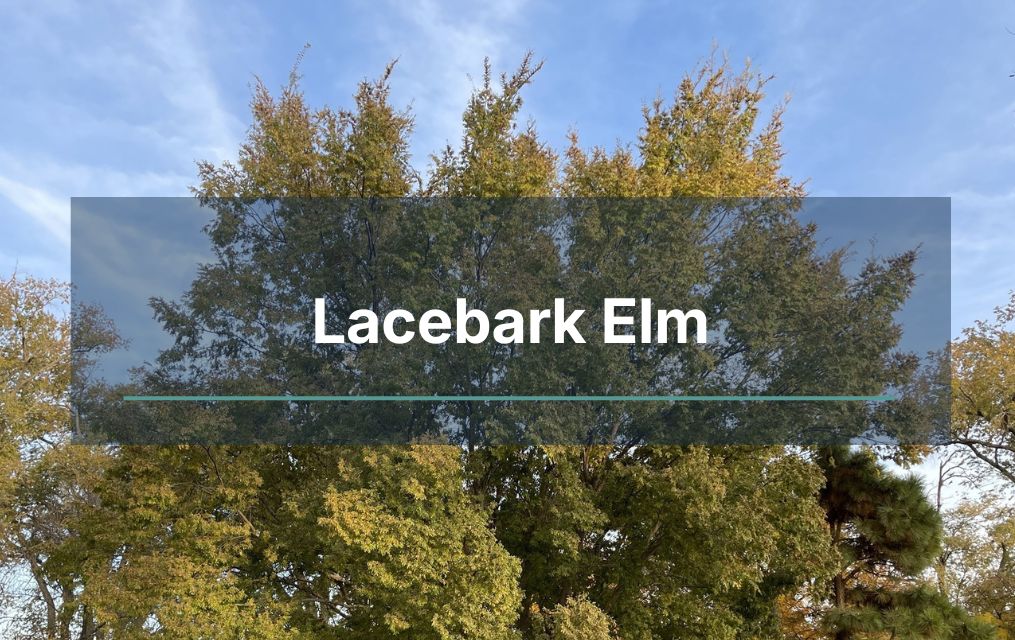
Elm trees often have a bad reputation around here, mostly due to the unremitting invasiveness and poor structure of one species, the Siberian elm (Ulmus pumila). It’s not the only elm out there, though! Its cousin, the lacebark (a.k.a. Chinese) elm – Ulmus parvifolia – is a strong-wooded, non-invasive and attractive tree.
The common name “lacebark” is very descriptive. When juvenile, the bark flakes off in chunks to reveal a more mature bark underneath. That mature bark often has a lace-like pattern. Overall, the bark of this species is much smoother and less coarse in texture. The scientific name “parvifolia ” refers to the small size of the leaves, when compared to other elm species. In 1997, Hilliers’ Manual of Trees & Shrubs (David & Charles, Newton Abbot, England) said of this tree, “…one of the most splendid elms, having the poise of a graceful southern beech.”
Like all elm species, this one grows in a vase shape. Early structural pruning can keep a single main leader in place until higher in the canopy, and the vase can open up from there. Sometimes when the branching begins very low on the trunk, it leads to a slightly weaker architectural form for the tree.
The small, wind pollinated flowers appear in early autumn. Honeybees sometimes visit to take pollen, as there is not much other pollen available at that time. In most years, the first hard freeze of winter hits before the seeds are mature, killing them. This really limits the potential invasiveness.
Contact us to find out more about our Albuquerque tree removal services.